Posts

Showing posts with the label Education Funding

Oppose House Bill 133 and Limits on Local Revenue for Education

Image
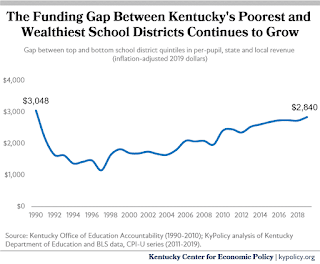
House Bill 133 is another bad deal for education.  It unfairly targets and would place limits on the ability of local boards of education to raise local funds for education. This is especially damaging at a time when the state has failed to keep the promise of fully supporting public education funding.   Since 2008 an increasing burden of education funding has fallen to the local level due to diminished state support.  For example, according to the Council for Better Education in the western Kentucky area the burden of local revenue has shifted in Bowling Green from 39 percent in 2008 to 47 percent in 2020, in Daviess County the shift of local funding was from 35 to 54 percent.  House bill 133 would deliver a double whammy by limiting the ability of local taxing authorities to make up for waning state support.   The current statute provides a reasonable process for communities to respond to tax levy proposals by local boards of education. The petition...

Groundbreaking Education Measure from Maryland Sets a Global Standard for Education Reform

Image
When the Kentucky Education Reform Act was passed in 1990 it was groundbreaking legislation that set the standard for the wave of education reform in the late 20th century.  This week the Maryland General Assembly's overrode Governor Larry Hogan's veto to pass an education reform and funding package that will likely set a new standard for education reform in the 21st century.  The Blueprint for Maryland's Future is based on the recommendations of the state’s Commission on Innovation and Excellence in Education, paves the way for Maryland to build a public education system benchmarked to the most globally competitive education systems around the world. The Blueprint legislation is the first in the U.S. explicitly designed to enable a state’s students to match the performance of students in the countries that lead the world in performance, equity, and efficiency. It provides Maryland with a fairer funding system and an accountability system that will assure that the policie...

KASA Call to Action on the State Budget

Image
 The Kentucky Association of School Administrators issued the following call to action today that may reflect the urgency of education funding:  “Increase SEEK base funding in HB 192, the FY22 budget. The SEEK program is the mechanism we use to fund Kentucky’s public schools. Raises for teachers and support staff, program enhancement for students, and providing adequate operational expenses for school districts are best achieved by a funding increase provided in the base SEEK program.” KASA’s legislative priority for P-12 education funding during the 2021 session of the General Assembly is:  Commit all growth in state revenues to increasing the SEEK base and restore SEEK and all other flexible focus funds (professional development, safe schools, textbooks, FR/YSC’s, etc.) to levels that provide constitutionally adequate funding to support academic improvement for all Kentucky students.   Adequate funding for elementary and secondary education is a constitutional mand...

Money Matters, Part 3-- Prichard Committee's "Big Bold Future"

Image
In this third post about the importance of money in public education, we will examine the impetus and rationale for a comprehensive P-16 approach to education funding from the Prichard Committee for Academic Excellence .  It is appropriate that such a bold plan should come from the Prichard Committee-- they played a significant role in the push for reform from the Rose decision through Kentucky Education Reform Act in 1990 and the reforms to higher education in the late 1990s.  Kentucky has made impressive progress in education over the past generation.  After vaulting from near the bottom to around the middle, P-12 metrics have hit a plateau , even moving backwards in some key areas – from preschool to postsecondary – with persistent gaps for those historically underserved. These plateaus were seen before the COVID-19 pandemic, and now, nearly one year since many students have seen the inside of a classroom, we now face learning loss like never seen before . Th...

Money Matters in Education, Part 2-- "The Cost Cutting Crusade"

Image
One of the most deceptive strategies of education reform over the past 20 years has been to sow doubt about the importance of school funding.  The approach has been advocated by those that do not want to increase the financial investment in public education as well as those who say the public schools are inefficient or ineffective. To sow doubt, they sold an outcomes based approach--using high-stakes standardized tests as evidence that public schools are failing.  This has been an effective mirage to bring the focus away from inputs and redirect efforts away from increased funding for schools. Authors Jack Schneider and Jennifer Berkshire describe this "cost cutting crusade" in their aptly named book  Wolf at the School House Door  (2020). The perpetuation of this myth has led many states to slash education funding as a way to experiment with tax cuts -- with little success. The most notorious case is Kansas, where Governor Sam Brownback promised that a moderate tax...

Reasons to Oppose House Bill 149 and Senate Bill 25

Image
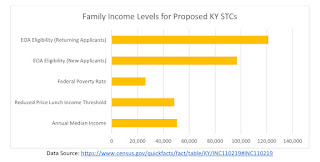
Don't be deceived by the name.  House Bill 149 , an act creating "opportunities in education" is bad legislation at the worst possible time. HB149 was drafted with the intent of providing tax credits to wealthy donors to give families the ability to use public dollars for private school tuition and for education-related expenses for all families. It is potentially devastating for public education in a state that is already financially sick. Anyone that works in or supports public education should oppose the bill for the following reasons outlined below from Abby Piper of the Jefferson County Public Schools and the Kentucky Association of School Superintendents : First, contrary to what many supporters will say, the bill does not target low-income families. Households making $96,940 per year for a family of four would be eligible – that number becomes $121,175 in income in the second year--which, as the chart illustrates, is over two times the median income for Kentuckian...

Kentucky's "Education First" Budget

Image
 Exactly a year ago, Governor Beshear and members of the General Assembly were beginning the work on what was billed as an "education first" budget.  Unfortunately, the pandemic interfered with the budget process and Kentucky-- like all other states-- went into fiscal survival mode.  Flash forward one year, the Governor and legislature have an opportunity-- despite the continuation of the pandemic-- to move forward with a budget that focuses on adequate funding of public schools.  While both the Governor and Republican controlled legislature will be touting education as a priority in this budget session, it is worth closely examining what an "education first" budget really means.  To really understand, we need to explore the debate about the idea that money really matters in education.  One of the most deceptive strategies of education reform over the past 20 years has been to sow doubt about the importance of school funding.  The approach has been adv...

Case Study on Education Fiscal Policy and Adequacy Funding in Kentucky compared to Kansas

  Adequacy funding in education is one of the defining education policy issues of the past 50 years. Since the economic downturn in 2008, shortfalls in state revenues have led to widespread reductions in state education budgets bringing adequacy arguments back to the forefront.  The attached link is a preprint of a case study that examines two states-- Kentucky and Kansas-- and compares the evolution of the politics and policy of adequacy efforts as an approach to education finance prior to and since 2008. The study is based on a white paper that I published for the Kentucky Superintendent's Association in 2019 and research that I conducted while studying education policy at Johns Hopkins University in 2018.   It is kind of a sad fact that challenges of adequacy funding have not become outdated.  Access the preprint here:  https://www.researchgate.net/publication/340953009_Case_Study-_Education_Fiscal_Policy